Showing posts with label Agnès Varda. Show all posts

Tuesday, May 1, 2007

The Criterion Collection #420: Le Bonheur

By Andrew Chan

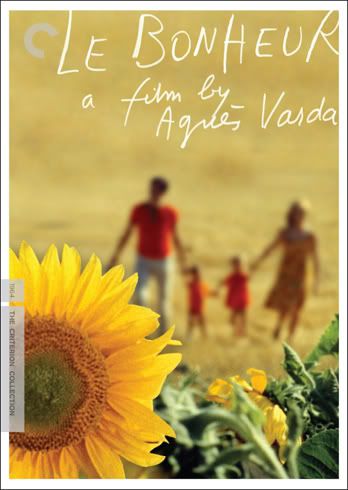
Shortly after making a then-controversial but now little-seen gem named Le Bonheur, Agnès Varda wrote that she had envisioned the film as “a beautiful summer fruit with a worm inside.” More than forty years later, one hears in this statement echoes of Buñuel’s anti-bourgeois perversity, Sirk’s subversion of lush surfaces and narrative clichés, as well as the basis for a whole tradition of American films (exemplified by David Lynch on one end and American Beauty on the other) that claim to expose the demons lurking behind the white picket fence. Then and now, there is a great pleasure in watching forces of chaos and insanity eat away at the glamour of cinema. When Le Bonheur (meaning “happiness”) opens to the carefree strains of Mozart and images of sunlight, sunflowers, and family members hand-in-hand, the contemporary viewer is immediately clued into the joke, having been taught by years of hyper-ironic filmmaking to respond to these symbols with scorn. We can already guess the film is about the tyranny of eternal happiness. What follows is, indeed, a story that demolishes the initial portrait of domestic bliss, replacing it with a version that is cruel and animalistic. But the predictability stops there. The power of Varda’s film is that it remains startling even in our savvy era, leaving us as uncertain and suspicious of its intentions as its first audiences must have been.

Like the title character of Varda’s 1985 film Vagabond, husband-father-philanderer François (Jean-Claude Druout) disregards the codes that dictate how life should be lived in Western society; the crucial difference here is that he inhabits a world of his own making, and is therefore free from being victimized for his behavior. Early scenes show him frolicking through nature with his two unnaturally obedient children, and sometimes making love to his beautiful wife on a blanket in the grass. When he falls for another woman, he does so with the innocent affection of a boy. He discovers, to his delight and convenience, that the adulterous affair enhances rather than detracts from his marriage, and he expects his wife to approve of the new circumstances. “Happiness works by addition,” he explains. If she is devastated by his admission, you don’t see it for a second on her face; love continues without question, at least until the plot twists toward an inevitable but ambiguous tragedy.
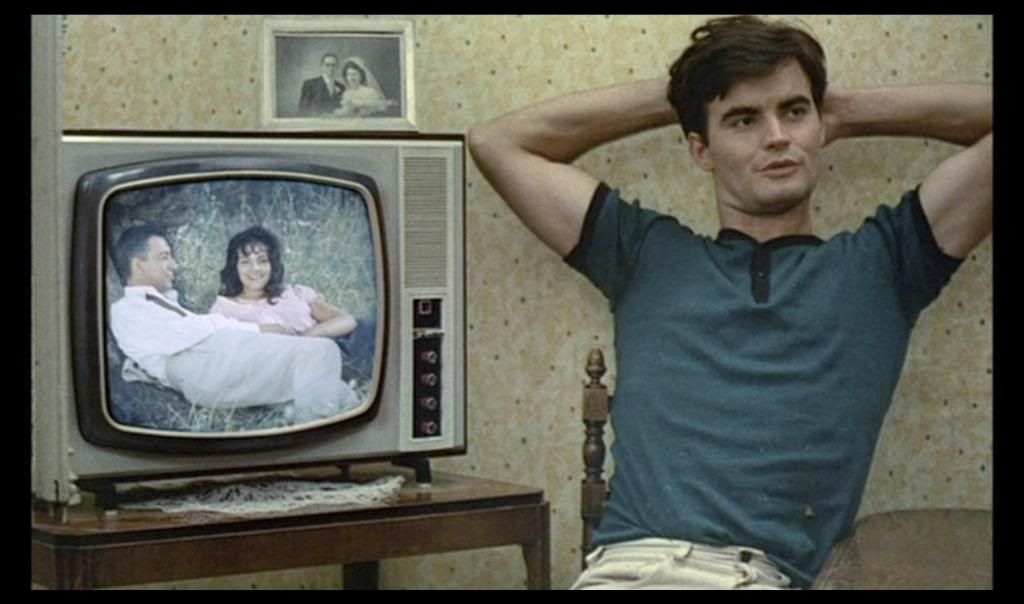
Part of the shock of the film is the insular space in which this cruelty occurs. There is no one to condemn François for his charmed life; only we, the audience, can submit an objection. The film buries the rules of moral society so deep within itself that it relies on us to provide those reference points, even as it gets in the way of our doing so. Varda performs a high-wire enactment of the egotistical, patriarchal psyche, taking the world exactly for what it is in the man’s imagination, and unifying so thoroughly with his perspective that his selfishness becomes all the more disturbing. Despite its resolutely sunny disposition, the film—interpreted as pure satire—is as acidic as anything by Catherine Breillat in its depiction of male-female romance, and as delirious in its mixture of sexual openness and sexual humiliation.

But art fueled by contempt alone is likely to run out of steam and, for this reason, what we first see as Varda’s unremittingly ironic tone always threatens to get heavy-handed. To fully appreciate how daring Le Bonheur is, we need to accept that our reading of the film as ironic is, in part, a partisan reaction, one that aligns with a certain side in the ongoing war of sexual mores. Yes, the film is an obvious attack on gender norms that discourage women from voicing their opinions and contradicting men’s desires; Varda sets up a masculine paradise in which lust and love have no emotional consequences, and asks us if we find it desirable. But in the peak decade of the sexual revolution, could she have meant at least some of her questionably utopian vision sincerely? Is François an unexpected hero, a man we should admire for being honest and unembarrassed with his desires? There is no way we can react to the ideal or nightmare presented in the film without revealing our own feelings on the current fads of sexual liberation, on polyamory in particular. But to really engage with the film’s ideas on love, sex, death, and family, we have to entertain the possibility that this version of paradise might somehow, in fact, be desirable. We might ask: If traditional notions of nuclear-family happiness are illusions anyway, then why should the idea of open marriages be so offensive to us? If we recognize that the messy nature of love has been obscured by our overly romantic expectations, then why is it so difficult to accept that multiple, simultaneous loves might be as sustainable as monogamous ones? Are our deep emotions and commitments just falsehoods we use to maintain the artificial separation between the human and the animal?
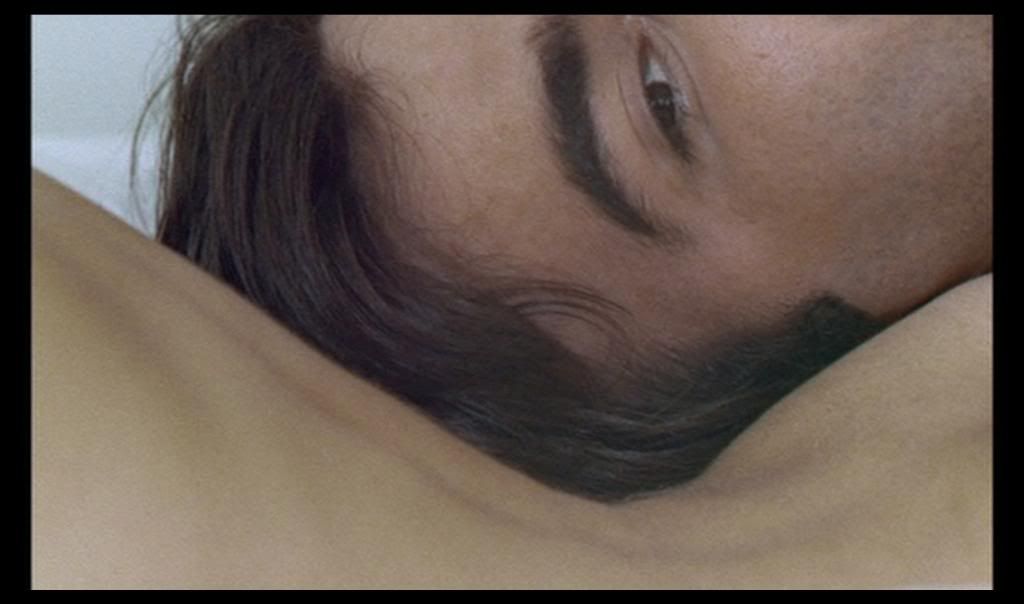
Even as Varda has us consider such questions, her conclusion about this exclusively male fantasy is clear. Whether we view Le Bonheur as dystopian (because its women are interchangeable and disposable) or utopian (because it embraces the full range of human beings’ unpredictable impulses) may, in the end, be immaterial. The film constructs an Eden, a world pre-shame, in which an individual’s feelings are wholly legitimate and never clash with those of anyone else. Varda establishes a vital link between morality and emotion, but the world she has created exists outside of both, and therefore outside reality. One of the most fascinating conflicts that arises in Le Bonheur (a film essentially about denying the existence of conflict) stems from the audience’s unshakable uncertainty of how to apprehend this self-conscious dream world. The film plants itself firmly in the leading male’s psychology, but it never exists in actual (rather than merely conceptual or symbolic) space. The characters are cardboard cutouts who never breathe, let alone choose, for themselves. At times, before its devastating cumulative effect sinks in, the film strikes one as stalling at the level of experiment, never quite making successful art or argument. But what consistently surprises is that, even through Varda’s caked-on style, François’ behavior still manages to unsettle us.

Le Bonheur emerges as a harsh critique of free love, as well as an empathetic exploration of its allure. The film’s visual splendor is both celebratory and elegiac. In Varda’s eyes, nature turns hideous, just like those feelings that (however “natural” to us) reveal our inhumanity. Varda knew something about the eye-candy of Technicolor (as perfected by her husband Jacques Demy in The Umbrellas of Cherbourg) and the soft, nostalgic palette of Impressionist painting, both of which she approximates in Le Bonheur’s cinematography. She knew those colors, like happiness itself, could never escape a look of fragility and impermanence: the sense that, with just a bit of rain, they would all wash away.

Le Bonheur may be numbered among the many precursors to radical works such as Blue Velvet and Fat Girl, but Varda’s film is moving in ways that a Lynch or Breillat could never be. Even the best of contemporary art dealing with the horror of the quotidian is usually snide and self-congratulatory, and never dares to confront the sweet emotions that can lead us to unintended cruelty, or the ingenuousness with which we harbor our most selfish desires. That good can produce evil, and that the beautiful coexists with the terrible, are facts that the typical movie (at most) only pays lip service to. Varda doesn’t deploy her stylistic audacity in order to disguise a lack of nuance or ambiguity. Even in a film as radically stylized as this, she lets all paradoxes stand so that the most improbable idyll becomes a mirror for our most complicated realities. The summer palette and sunflower imagery might scream irony at first, but it’s not the kind of eye-rolling sarcasm that you can trust or participate in. Instead, it’s disorienting, a trapdoor that opens onto a profoundly uncomfortable moral dilemma.

***

Image/Sound/Extras: Perhaps the least-known of the four films in The Criterion Collection’s 4 by Agnès Varda, Le Bonheur comes to us in vibrant color, gorgeously restored; as we learn from one of the disc’s many supplements, the film had to be reconstructed because the 1963 Eastman negative had gone completely pink and beige. According to Varda, who makes several charming appearances throughout the box-set and is listed as “Consulting Producer” in the DVD credits, this version looks identical to the original.

Two featurettes consist of reminiscences by the cast on the film's production and reception. In an interview with the lead actresses Claire Drouot (the real-life spouse of Jean-Claude Drouot) and Marie-France Boyer, we learn some heartfelt, down-to-earth lessons on matrimony. Drouot, who after almost 45 years is still married to the film’s star, offsets Le Bonheur’s sharp satire with some practical advice: “There’s no user’s manual. [Marriage is] a craft, it’s like knitting. You take two needles, and you knit. That’s all.” In another short piece, Jean-Claude Drouot—now scruffy, broad, and deep-voiced—returns to the setting of Fontenay-aux-Roses in southwestern France to speak with locals who remember witnessing the film in production. Also included in the package is some black-and-white TV footage chronicling the making of Le Bonheur, during which we catch a glimpse of Varda in the director’s chair sharing a few words with her husband, the great Jacques Demy.

Perhaps the most interesting extra feature is a 15-minute discussion among a diverse gathering of French intellectuals who either remember seeing the film upon its release or have just encountered it recently for the first time. The comments are not always enlightening, but their exchanges evoke a time and culture in which art films were seen as instigators of philosophical discussion. It is surprising to hear some suggest that Le Bonheur is not a completely mordant comedy, and that it might have its share of genuinely utopian values.

Most inconsequential and irrelevant among the extras are two shorts on the general meaning of happiness, in literary history and on the streets of contemporary France. Most valuable, by far, is the inclusion of Du côté de la côte (1958), Varda’s wonderfully cheeky 25-minute travelogue of the French Riviera. Along with 2000’s The Gleaners and I, this short demonstrates Varda’s gift for inserting playful imagery into a genre as traditionally sober as the documentary. The film, like all her best work, shows her preference for a complex, pliant tone that can express her whimsy, outrage, and melancholy.

_____________________________

Andrew Chan is a poet and film critic currently studying at UNC-Chapel Hill. He is the creator of the blog Movie Love.

Read more!

The Criterion Collection #419: La Pointe Courte

By Andrew Chan

In the first shot of Agnès Varda’s La Pointe Courte, the camera travels down a corridor in a small fishing village on the Mediterranean coast, brushing against the hanging laundry and peering into open windows. The first several scenes are spent getting acquainted with the town, the difficult work the inhabitants engage in everyday, and the little tragedies befalling them that they accept without melodrama. Soon a couple in urban dress drifts into the frame. We see them from the back at first and then from the front; they are silent at first but then, all of a sudden, extremely talkative about the problems that plague their young marriage. The man (Philippe Noiret), who grew up in la Pointe Courte, is satisfied with the relationship, but the woman (Silvia Monfort), a Parisian, craves something else that she cannot define. As sorrow piles on top of sorrow, the film maintains its surpassingly gentle touch, lightening the mood at times with whimsical music or an eccentric detail. Moving forward and pulling back, it travels between the worlds of the villagers and the spouses, and keeps them separate until a final sequence gathers everyone at the town’s ritual jousting match.

Using this two-stranded pattern, Varda weaves together a film about the communal voice that forms among people—not just the largely anonymous villagers, but also the individualized spouses, who are bored with the intimacy and familiarity that has them speaking each other’s sentences. Knowledge is the other overarching theme: our inability to disown what we know; our desire to always seek the excitement of what we don’t; and the kind of love that forms from knowing people, places, and customs so deeply that you cannot distinguish them from yourself.
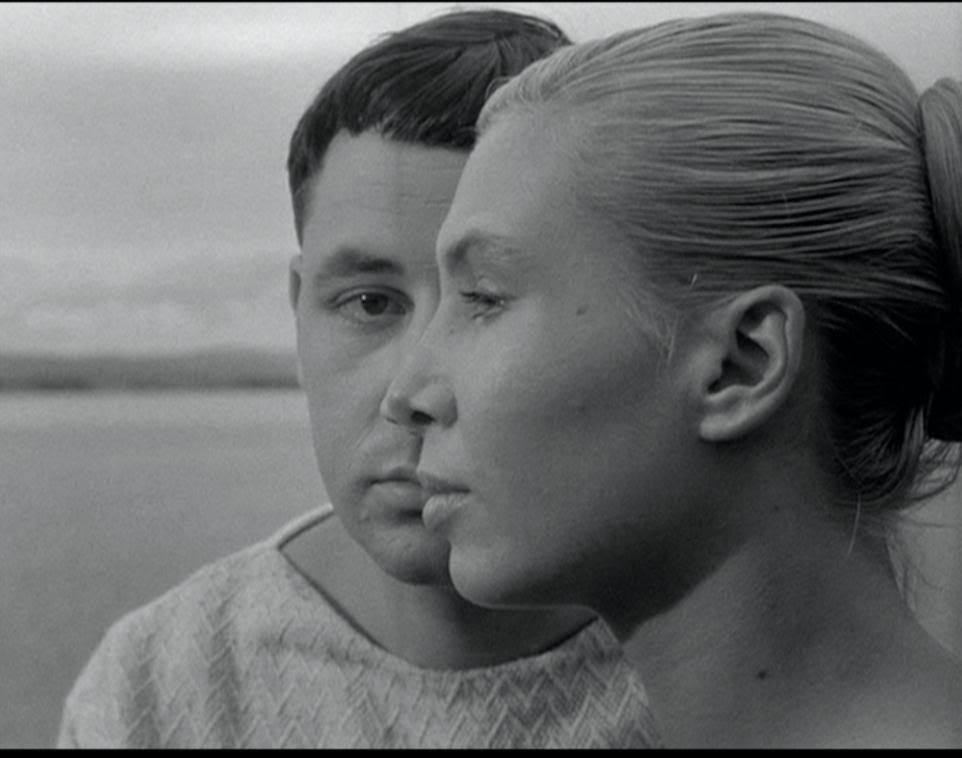
As one of the few low-budget French films of its era, the debut of one of the nation’s great unsung directors, and the inadvertent inauguration of the French New Wave, La Pointe Courte is easier to watch today as a historically important artifact than as an aesthetically accomplished artwork. One of its non-textual attractions—as with any work retrospectively positioned as a milestone—lies in the opportunity to reconstruct our mistakenly linear narratives of cinema history around it. Although Varda has famously claimed that she was film illiterate when she began work on this project at the age of 25, the film’s indebtedness to Italian neorealism of the ’40s is as unmistakable as its anticipation of the key works of European cinema that would follow. Its extraordinary visual sophistication recalls the poeticized vérité of Luchino Visconti’s fishing-village epic La Terra Trema, even as Varda’s approach diverges from the neorealist taste for heart-tugging melodrama and goals of political agitation. Also, preceding the first of Bergman’s most popular dramatic films by at least three years, La Pointe Courte can be viewed as a step in the development of the ponderous confessionalism that would become fashionable in the Swedish auteur’s work. Surprisingly, in one of the film’s most distinctive shots—in which half of the husband’s face is covered by the wife’s profile—the link to Bergman appears to be visual as well, presaging the geometrically designed close-ups in Persona (1966) and Cries and Whispers (1972).

But the film that La Pointe Courte most strikingly calls to mind is one to which it shares closer national, ideological, and stylistic ties, namely Alain Resnais’ frustrating masterpiece Hiroshima mon amour, which was produced five years later (perhaps not so coincidentally, Resnais was one of La Pointe Courte's editors). Varda’s debut feels like a milder ancestor to Hiroshima, centering itself (with less anguish and more warmth) on identical issues of place, identity, and the historical baggage of cross-cultural relationships. Varda employs the same stylized language in the dialogue she gives her actors, which reads as exchanges of monologues rather than genuine engagements in conversation. The register and cadence are that of the stage, with inflections (occasionally) of the poetic and (at worst) the thuddingly philosophic. The stylistic traits that La Pointe Courte and Hiroshima share—the marks of an era striving for serious, adult themes in its movies—are exactly those that severely date them, and make them difficult for some contemporary viewers to appreciate. At this early stage in her career, Varda’s sense of cinema was relatively stilted, based primarily on what she learned from her photographic and academic backgrounds—an understandable weakness for a first-time director with no training in film, but one that she would outgrow by the end of the decade.

The age-old problems of cinema and literariness raised by La Pointe Courte’s dialogue extend to the film’s audacious structure, which Varda has admitted to borrowing from William Faulkner’s 1939 novel The Wild Palms. By placing a love story (essentially a couple’s ongoing duet) at the center of a comparatively diffuse, polyphonic portrait of a community, Varda’s set-up shows the potential to teach us how conflicting genres can speak to each other. One major advantage of this form is the way the social consciousness of the film’s neorealist sections acts as a check on the self-absorption of the spouses’ philosophizing. But too much of the film’s tension (between both characters and genres) remains on the page, stifled underneath an overly neat theory. It is Varda’s fully formed visual sensibility that allows us to forget the insistent literariness of her script. Long scenes of the couple’s back-and-forth are punctuated by lovely observations, such as that of a crab scuttling through water, or a slippery sea creature coiled in a bucket. But the film’s most breathtaking moments are not limited to images of the natural world. My favorite scene occurs when Monfort and Noiret crawl into the belly of an abandoned ship, and are cradled in its shadows.

If La Pointe Courte is indeed the first major film of the French New Wave (as many scholars now acknowledge), predating even 1958’s Le Beau Serge, then why is it excluded from popular histories of that movement? Some of the more obvious answers include the institutional sexism that made the nouvelle vague a boys’ club, as well as Varda’s career-long alignment with the period’s less commercially appealing Left Bankers (Alain Resnais, Chris Marker), who did not share the common link of Cahiers du Cinéma that united auteurs as disparate as Rohmer, Rivette, and Chabrol. In addition, unlike the more popular Cléo from 5 to 7—though not dissimilar from, say, Rohmer’s Moral Tales—La Pointe Courte is completely lacking in the youthful bursts of energy found in a film like Breathless. It is, after all, partly about a couple’s quiet initiation into adulthood, that threshold past which an authentically youthful perspective of the world is all but irretrievable.

Alternately cynical and optimistic, Varda’s film encourages an outlook of acceptance: in the marriage melodrama, it muses on the inevitability of diminished passion and erotic feeling, and in the neorealist sections, it reconciles with the naturalness of death. That Varda adopts this view without draping her film in melancholy is a rare achievement, unfortunately marred by a conclusion that feels pat and unearned, like a naïve person’s affectation of maturity. In spite of its flaws, though, La Pointe Courte establishes many of the trademarks that have defined Varda’s career up to her last major feature, the 2000 documentary The Gleaners and I, including her resourceful use of settings, her acute eye, and a remarkably complex and distinctive modulation of tone. Already apparent are qualities that could be seen as having filtered down to (if not having directly influenced) a loose-knit feminist aesthetic in contemporary French cinema: the lyricism and stillness that Claire Denis has taken to new heights and lengths; the alertness to both nature and the nuances of female agency found in the work of Pascale Ferran. Calling Varda “the Grandmother of the French New Wave” may in fact do a disservice to a legacy that long ago transcended the zeitgeist it fostered.

***

Image/Sound/Extras: Spanning three decades in the career of a filmmaker who has been active for more than fifty years, The Criterion Collection’s 4 by Agnès Varda gathers together uniformly superb transfers of four fiction features and three shorts. Also included is a trunkload of extras, many of which seem to have been specifically designed for this set. Taken together, the films show the remarkable growth of an artist, as well as the shifts of aesthetic and thematic preoccupations across the second half of cinema’s first century. What the disc for La Pointe Courte lacks in the variety of material that supplements the three other titles, it makes up for with two substantial interviews of the director—one shot recently in her office in France, the other cobbled together from excerpts of a 1964 episode of the TV show Cinéastes de notre temps. The contrast between the younger and older Vardas is a pleasure in itself, but both featurettes also have a great deal to say about the circumstances under which her career in film began. Produced at a time when aspiring French directors had to climb the studio ladder to make their first feature, La Pointe Courte was the act of daring that jump-started the New Wave and its promotion of personal cinema. Varda recalls the film’s journey from Cannes, where it received critical acclaim but no interest from distributors, to Paris two years later, where it quickly became a favorite among intellectuals and taste-makers.

_____________________________

Andrew Chan is a poet and film critic currently studying at UNC-Chapel Hill. He is the creator of the blog Movie Love.

Read more!

Monday, January 1, 2007

The Criterion Collection #74: Vagabond

By Andrew Chan

Despite the persistent belief that great art is driven and justified by an intellectual (rather than emotional or aesthetic) impulse, it is in fact difficult to make a film whose basis is conceptual without the results coming off as simplistic or overly designed. Such films present themselves with the challenge of filtering the world through an idea, a phrase, or even a single word, and ultimately fail if the starting-point diminishes our worldview rather than expanding or complicating it. There are, of course, some outstanding examples of films that wear their thematic concerns on their sleeves while also succeeding as art, one being Kieslowski’s Decalogue, which addressed the limits of its approach by embracing and revising the old form of the parable. Another example would be the major films of Agnès Varda, which employ a mode of storytelling that launches from ideas, or from the rickety language we use to encapsulate ideas, and risks the theoretical and the literary in order to achieve (at its best) a beautifully nuanced metacinema. With the Faulkner-inspired structure of La Pointe Courte, the real-time experiment of Cléo from 5 to 7, and the explorations of one-word concepts (“happiness” and “gleaning”) in Le Bonheur and The Gleaners and I, Varda encourages her audience to question the ways in which movies construct, interrupt, and sometimes collapse the narratives and meanings they put forth.

In 1985’s Vagabond, which won the Golden Lion at the Venice Film Festival and is still probably her masterpiece, Varda’s affinity for the conceptual manifests itself both stylistically and thematically. But her career-long suspicion of any conclusive vérité that might be extracted from cinema makes for a film that revolves around ambiguities and questions rather than big statements; in fact, Varda goes so far as to remind us of this early on with a shot of a red question mark painted on the wall of a building. Like La Pointe Courte and Cléo from 5 to 7, Vagabond operates on a structural gimmick; evoking Citizen Kane, Rashomon, and (according to Varda) the experimental novels of Nathalie Sarraute, the film sets out to reconstruct the life of a dead woman named Mona (Sandrine Bonnaire) through a series of rambling flashbacks punctuated by uniformly terse, direct-to-camera testimonies from people who were acquainted with her.
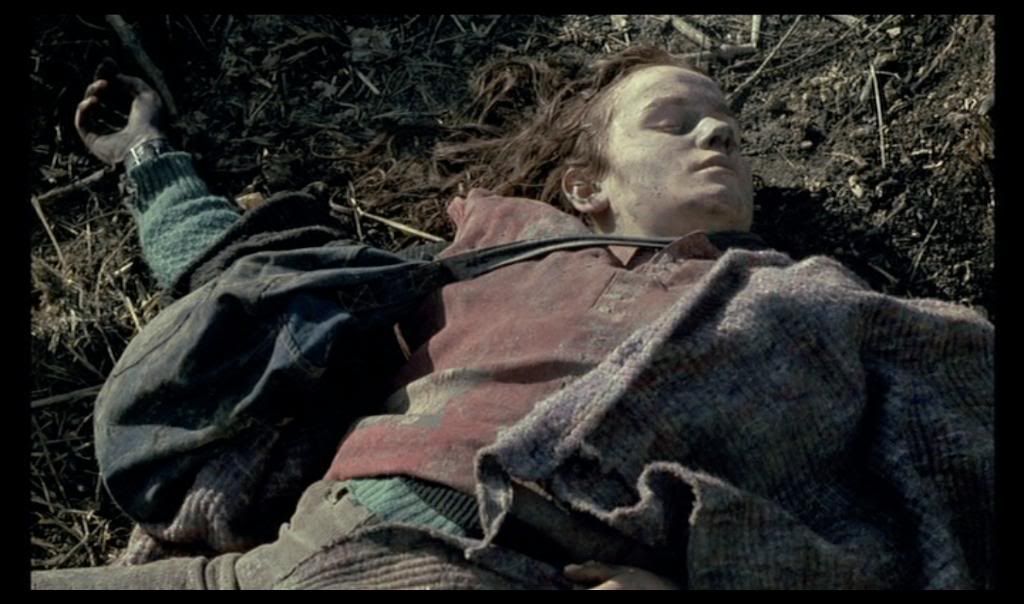
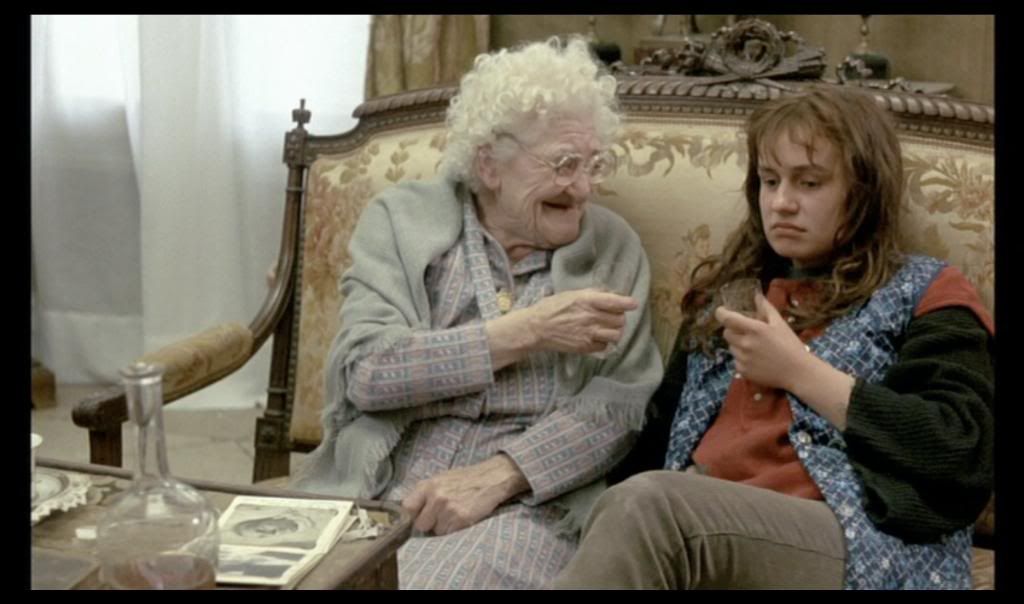
Found frozen to death in a ditch in the opening scene, Mona is revived as a subject for investigation. We learn that she was a drifter but are only given clues to her former life as a typist and vocational school drop-out; we discover nothing of where she used to live or the family she has run away from. As the film moves from scenario to scenario, we meet men who found her sexually unyielding, overly idealistic, or unappreciative of their charity; and women who were fascinated or repulsed by (or even jealous of) her complete disregard for social norms. Highlights among these characters include a hippie who gives Mona shelter; an agronomist who takes her on as a kind of sociological project; a Tunisian migrant worker who promises to take care of her; and a maid who views her as a romantic figure capable of drawing out passion in men. In this tangle of flimsy interpretations, Mona hardens into a new cinematic archetype: a young female rebel who is genuinely without a cause. But neither Varda nor her audience is capable of summoning interpretations that are not ideological or poetic, even though Mona’s journey is strictly non-ideological and non-poetic. We are led back to the devastating old cliché that nothing and no one can be fully known, since knowledge is dependent on competing subjectivities.

While the Welles of the ’40s and Kurosawa of the ’50s were a little too pleased with their innovations, directing as if they were the first filmmakers to discover truth’s slipperiness, Varda’s own take on this classic multi-POV structure shows ease and mastery worth those intervening decades. Vagabond begins creakily with Varda as narrator, already mythologizing Mona as some magical creature from the sea; one would be forgiven for anticipating a control-freak of an auteur who won’t stop flaunting her own devices. But the voice-over is dispensed with, and Varda’s grip on the material becomes looser, as if to match the grunginess of her anti-heroine. As she contrasts the overlapping truths emerging from her eccentric cast of characters (most of whom are played by non-professional actors), our attention is directed away from intellectualizing Mona’s splintered identity to experiencing it. Varda’s concept-driven style remains fluid; it rarely overstates itself, and exhibits the director’s willingness to step back and let Bonnaire’s remarkable performance embody not just ideas but also a credible, fascinating, individual self. Despite the faultiness of truth, the film allows for the fact that someone actual is being resurrected here; in a sense, cinema makes real; and the truths about Mona that have been omitted or obscured are no greater than truths omitted and obscured in the constraints of any fiction or non-fiction narrative. In the wild eyes of a precocious actress (Bonnaire was only seventeen at the time of production), Mona’s doom, charisma, and affected dispassion take on a documentary-like authenticity, comparable to legendary direct-from-the-streets performances such as Fernando Ramos de Silva in Pixote.
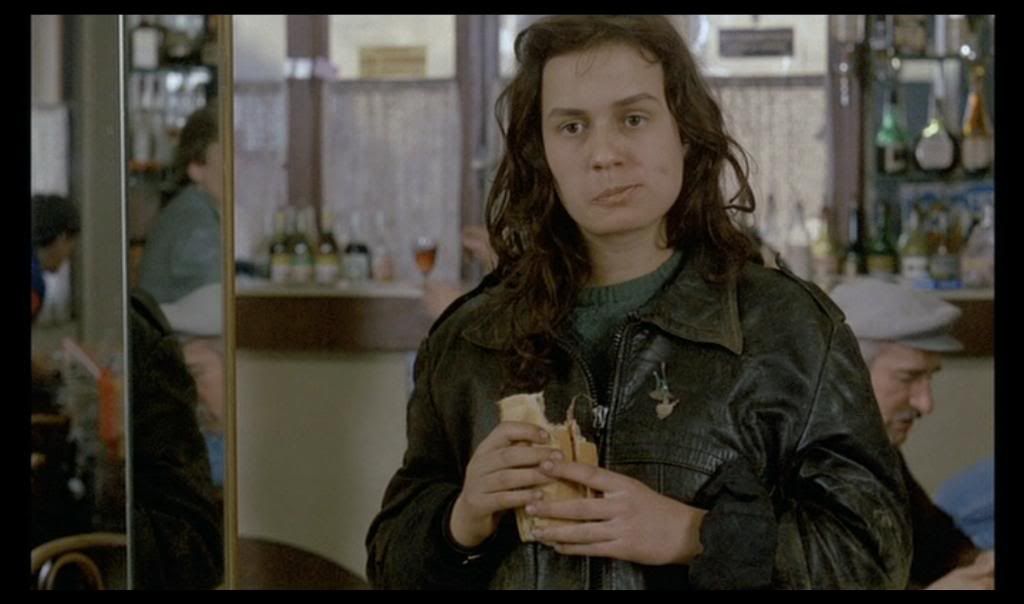
The major theme of Vagabond turns out to be another concept: freedom. (The film would make an interesting double feature with Kieslowski’s upper-class Blue.) The cost of being completely free of society’s expectations, the pain of relationships, and the boredom of work is being, in the end, completely alone. It is clear not only that Mona has liberated herself from the drudgery of what she saw as limited, quotidian options, but also that she is free from making the sacrifices domestic women are forced to make when they marry men. In the ’80s, the phenomenon of “homeless and lawless” women (in the words of the film’s French title, Sans toit ni loi) was still quite new in France. Varda makes a distinction between the reactions Mona receives from the different genders; men, on their motorcycles and in their trucks, often look past Mona’s filth and see a potential sex object, while women see a possibly feminist pioneer who fends for herself in a male world. The film is, on the one hand, repulsed by Mona’s unladylike filth (the camera catches her cleaning out her nose on more than one occasion) and her rejection of all things passionate and interpersonal, but on the other hand, it can’t help but celebrate her almost pious reduction to an elemental existence. This sympathy arises in spite of the fact that Mona never becomes a sympathetic character.

Even more urgent than the film’s ideas on freedom is this question of sympathy, which is a sly but forceful implication of the audience. The film implicitly asks: What qualities are required for a person to be deserving of other people’s compassion? The same question was hurled last year at the Thoreau-wannabe in Into the Wild, another willfully irresponsible outcast who, one might argue, also brought tragedy on himself. But Vagabond is much less romantic and transcendent than that film, or almost any other film about drifters that has followed it. With dirt-colored cinematography, prickly textures, and an eerie violin score that mimics a lacerating wind, it rarely gives us refuge from the harshness of its exteriors; it seems that few films have ever been set at such a merciless physical and emotional temperature. When we first see Mona’s dead body in this dead landscape, our impulse is to search for the victim, the martyr, or the symbol in her.
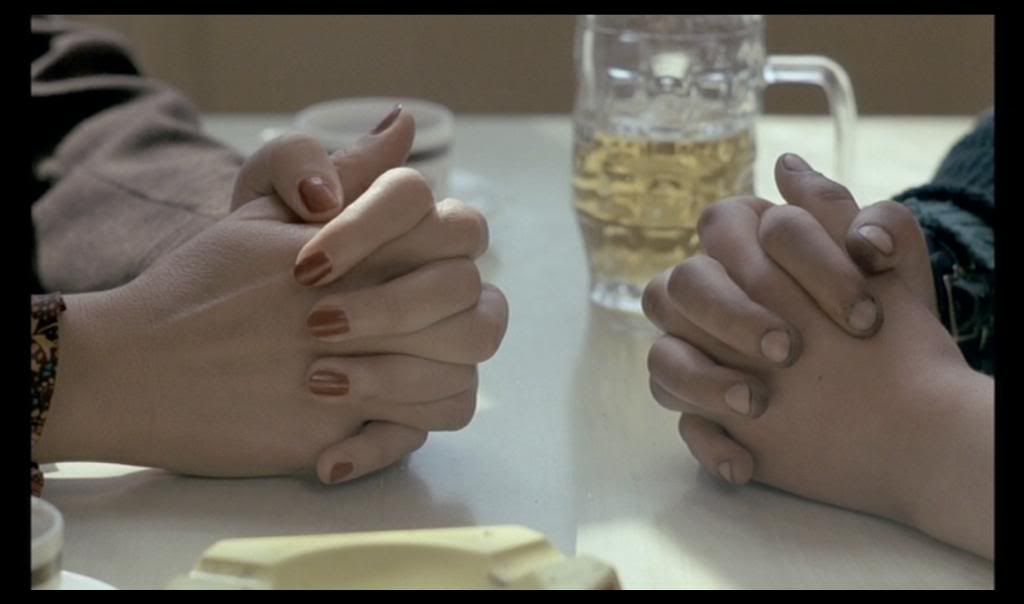
But we can’t pity her the way we do Lars von Trier’s put-upon stoics; we learn soon enough that she’s an unapologetic nihilist who has no interest in saving herself, let alone the world. What place does our compassion and charity take in this story? How do we explain her motivations to ourselves? Is she responsible for the choices she makes in a world that seems to be without real choices? Can we dismiss her as the product of social oppression or psychological illness, or do we find pieces of our most fundamental fears and longings in her? These questions go to the heart of how poverty, pain, and filth continue to be moralized in our society. Vagabond, one of Varda’s most shrewdly political films, recognizes the privileged position cinema places us in by offering entire lives up to our scrutiny. It makes itself equal to such a responsibility. The film’s great achievement is a character who repeatedly confounds our most ingrained senses of judgment.

***

Image/Sound/Extras: The fourth disc in The Criterion Collection’s generous and eye-opening set 4 by Agnès Varda, this is an update of an extra-less version the company released in 2000. Image and sound are as immaculate as one would expect from a new high-definition digital transfer supervised by the director herself. The illuminating essay included with the package, written by critic Chris Darke, is a vast improvement on the one by Sandy Flitterman-Lewis found in the earlier edition. But the real highlights here are a new bounty of supplements: these include the forty-minute making-of documentary Remembrances, in which we get to see an older, shockingly glamorous Sandrine Bonnaire; a brief interview with composer Joanna Bruzdowicz followed by a back-to-back presentation of all the film’s dolly shots; a 1986 radio interview that explains why Varda dedicated the film to the French novelist Nathalie Sarraute and which suggests a kinship between these two underappreciated, groundbreaking female artists; and, perhaps best of all, a short tribute, in much-degraded 16mm, to the charming actress Marthe Jarnais.

_____________________________

Andrew Chan is a poet and film critic currently studying at UNC-Chapel Hill. He is the creator of the blog Movie Love.
Read more!

The Criterion Collection #73: Cléo from 5 to 7

By Andrew Chan
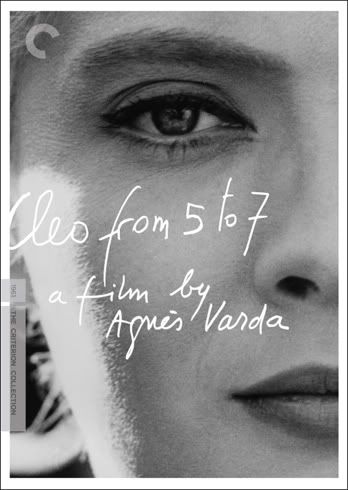
Agnès Varda’s Cléo from 5 to 7, the film that put the “Grandmother of the French New Wave” on the international map, follows a pop singer (Corinne Marchand) through the streets of Paris as she awaits medical results that will report the severity of her cancer. Captured in approximate real time, her journey begins in a fortune teller’s office; within minutes, a foreboding tarot reading has her convinced she’s done for. But the film that follows is never chained to the heroine’s sense of impending doom. From start to finish, Cléo is a remarkably tonic portrait of urban anxiety, the sloth of the privileged, and the hazards of day-to-day, hour-to-hour living. Usually identified with the more serious and radical Left Bank division of the New Wave (which also included Alain Resnais and Chris Marker), Varda adopts the free-spirited attitude of Truffaut and Godard’s earliest popular successes, resulting in a film that is both a study in stylistic possibilities and a valentine to urban life.

Varda has stated that Cléo marked the first time she was able to reconcile her interest in the artificial, reconstructive properties of film with the medium’s capacity for authentically documenting the real world. This tension between the natural and the fabricated echoes not only in Varda’s stylistic flourishes (her idiosyncratic editing; her thrilling mixtures of genre) but also in the personality and predicament of her title character. Has there ever been a tragic heroine as unimposing as Cléo, or a depiction of illness as deliberately on-the-surface as in this film? Varda commits her first transgression by setting Cléo during what she admits are the raciest two hours in everyday French life, that period typically set aside for an evening roll in the hay. The film departs from our expectations of how the ill should be represented onscreen, the departure being particularly jarring because Varda introduces that weighty word “cancer” right off the bat. The audience’s immediate desire is to sympathize with Cléo, to heroize her, and to be helped along by some wholesome, old-fashioned melodrama. Instead, we find Cléo concerned about her potential loss of youth and beauty, constantly staring at herself in the endless hall of mirrors formed by the shop windows of Paris. Soon enough, we find her concerns pushed to the film’s margins time and again by more frivolous attractions.
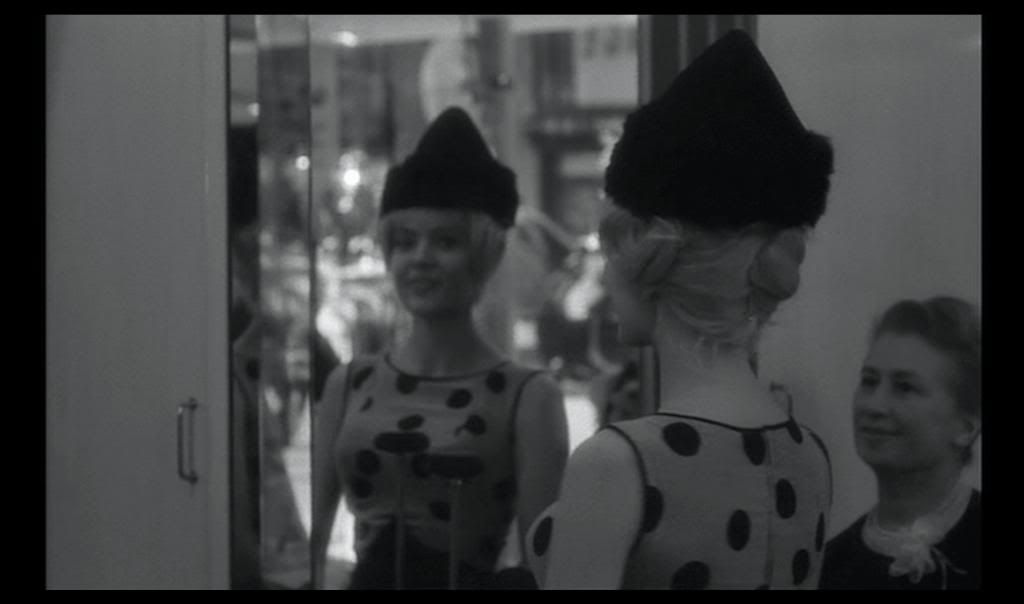
By surrounding Cléo in an environment of blithe obliviousness, Varda would have us convinced that the central drama here—the gut-wrenching anticipation of destiny; the misfortune of a possibly premature death—is of no real import. This unsentimental strategy allows us to discern one of the central issues laid out in the film, which concerns the rules of public emotional display. How does a film (or a person) weigh private fears against the social (and even political) priorities of the world? In one scene, Cléo walks into a restaurant for the sole purpose of playing her latest song on the jukebox to gauge the customers’ (largely indifferent) reactions. Moments later, she is riding in a taxi, hearing celebrity news about the recovery of Édith Piaf from surgery, and world news about the Algerian conflict. In this clever juxtaposition of audio, we are confronted with the fundamentally feminist question of where an individual woman’s anxieties stand in the grand scale of a busy, tragic world, as well as the humanist question of how we look outside ourselves without our personal suffering being illegitimated.

Whenever Varda decides to bring on the old-school heartache, she does so using the most transparently artificial means. On the rare occasions that we are allowed to plunge into Cléo’s psyche, we either hear her thoughts in voiceover, or experience her fear through a series of jump-cuts. The first time Cléo breaks into tears is exactly the point at which the film’s emotional expression and its transparency as film collide. In one of the most astonishing scenes, the camera starts off observing Cléo at rehearsal, slides in to frame her in the manner of a musical number, then quickly zooms out to jerk the audience back into the film’s “standard” layer of reality.
Real-time structure always positions a movie at the center of cinema’s oldest genre division: the split between documentary and fiction which Varda has mined throughout her career. Approximations of “real time” in movies are usually undertaken with the intent of establishing a heightened reality. But attempts at this challenging stunt are few because, no matter how realistic cinema may pretend to be, it always exists in a separate universe, one whose sense of time moves according to the characters’ emotions or the director’s idea of what will keep an audience interested. As a gimmick, real time holds such fascination precisely because it is so confused about what it wants to achieve: while in theory it strives for slice-of-life naturalism, in actuality it can never divorce itself from the wish to be audacious, pyrotechnic, virtuosic—the same wish that, to a certain extent, underlies all our notions about the magic of cinema.

The most famous examples of real-time experimentation have a decidedly non-naturalistic effect: Hitchcock’s Rope looks staged; Sokurov’s Russian Ark is sublime and hallucinatory; Linklater’s Before Sunset practically swoons as each second passes by. As in life, the typical film takes time’s passage for granted. But in real time, that passage is isolated and can become more entrancing than even the visual, spatial or aural qualities of a film. In Cléo, Varda invokes the concepts of realism and naturalism implicit in the use of real time, but she also does everything in her power to challenge them by slicing up the flow of time with her sometimes startling edits, and saving the film’s longest takes for the end so that they feel like a breath of fresh air, or a sigh of relief.
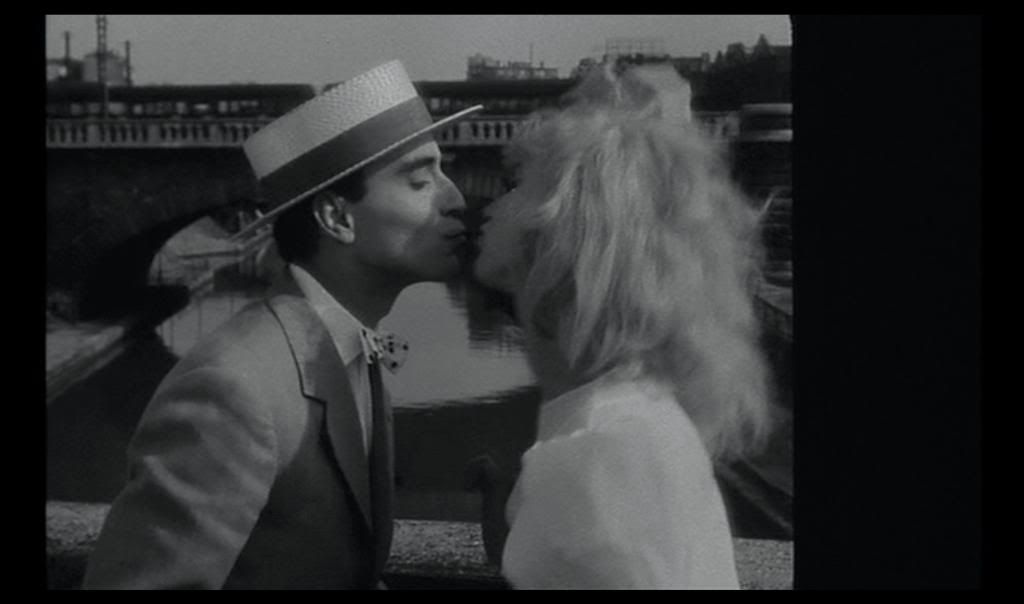
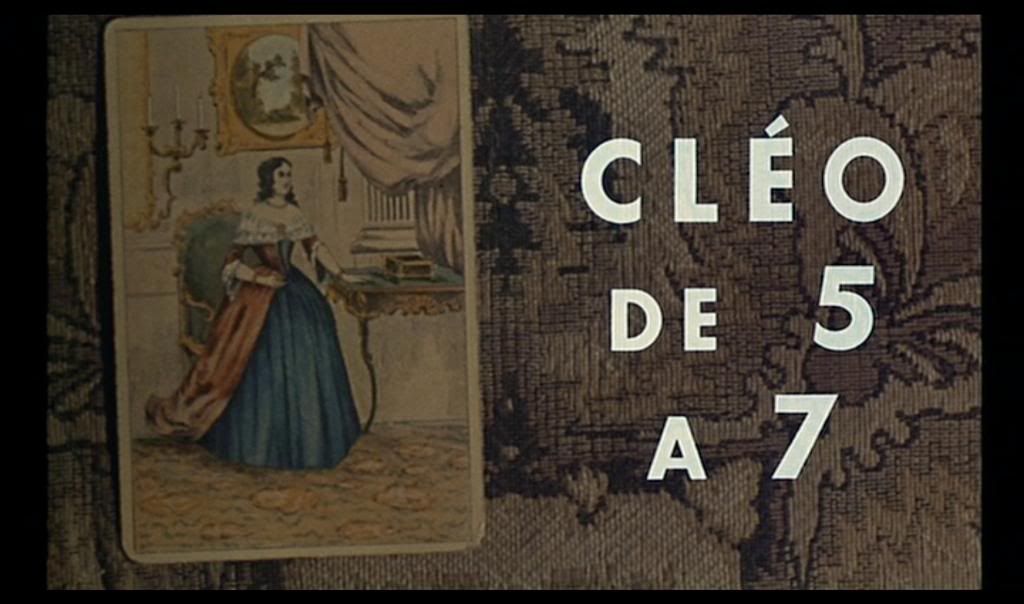
Cléo moves in sections, with each new chapter title announcing not just the starting but also the ending time of a sequence. This formalist gesture attempts to toll us back to our conception of the film as an exercise in realism. But the principal delight is in watching Varda break her own rules. She has never been a minimalist, and far from being an attempt at “pure,” aesthetically chastened cinema, this film makes its audience aware of the many tools that lie at a director’s disposal. Beginning with the transition from color to black-and-white in the film’s first chapter, we are made conscious of the wide assortment of tricks being played, and as Varda adds on fractured editing, Michel Legrand’s lovely score, claustrophobic art direction, and collage-like bits of sound design, we get the sense that each moviemaking mechanism constitutes another layer of (or an additional distance from) reality. As much as Breathless or Shoot the Piano Player, Cléo is built on a relationship to movie-loving culture. Not only does the film feature cameos from Godard and Anna Karina, but these appearances occur in their very own set-piece: a film within the film. The mounting joy we feel in the final scenes is plugged directly into our cinephilia, as the film becomes reminiscent of great movies that were made before it (particularly Murnau’s Sunrise and Minnelli’s The Clock) and after it (Before Sunset).

Lying underneath the film’s ostensible obsession with time is Varda’s carefree, pleasurable pacing. Where real time rendered Hitchcock stilted, it made Varda jazzier, certainly freer and more associative than in her carefully scripted debut, La Pointe Courte. Cléo shuffles along leisurely, big-hearted and receptive to all the distractions that come its way, at times falling into some of the most rapturous moments to be found in the Varda canon. Marchand’s performance hits its peak when Cléo, in her first moment of complete solitude, descends a set of stairs toward a park, singing and puckering her lips like the star of her own revue. In this late scene, we understand for the first time that—as much as Cléo’s outwardly driven personality and hunger for attention have been influenced by a culture that demands women be image-conscious—our heroine is also, at the end of the day, a natural born performer.

Cléo isn’t the prototypical feminist classic chronicling a woman’s journey from submissiveness to assertiveness, or from silence to self-articulation. The film spends much of its time insisting upon its heroine’s superficiality, refusing to ennoble her even as she carries the burden of a ready-made martyr. The beauty of her ultimate revelation is that, even though it results from an encounter with romance, it occurs modestly, without an ecstatic climax. Throughout the movie we’ve seen Cléo do nothing but perform and act out, so what strikes us most about this ending is her non-performing, and the fact that Varda and Marchand feel no need to compensate for her by bestowing the external markers of a wise, liberated female. Cléo and her true feelings remain mysterious and amorphous, breaking with a long tradition of histrionic silver-screen sufferers. In a film possessed of such youthful, quintessentially New Wave faith in the powers of cinematic style and technique, the director’s vision falls on the side of what cannot be filmed, or even said. Cléo—at the brink of what could be true love—finally stands on her own, proving herself to no one, including the film’s audience.

***

Image/Sound/Extras: Updating an earlier Criterion edition issued in 2000, this new DVD of Cléo from 5 to 7 (available only as part of the magnificent package 4 by Agnès Varda) features a restored digital transfer, as well as the set’s largest treasure trove of supplementary material. A good portion of these extras are dedicated to emphasizing the film’s intimate sense of place. In one 35-minute featurette, Varda interviews Corinne Marchand and Antoine Bourseiller at the locations seen in the final sequences of the film. In another, we are offered a swift trip by motorcycle through present-day Paris, recreating Cléo’s 90-minute journey through the city. The disc’s most amusing curio is an excerpt from a 1993 French TV interview, in which Varda praises Madonna’s “natural” acting ability, and the pop-star herself explains why she pursued the role of Cléo in an American remake that never got off the ground.

Inexplicably buried at the bottom of the DVD cover’s list of special features, Varda’s 1958 short film L’opéra Mouffe is actually one of the best discoveries the entire box-set has to offer. Introducing itself as a diary of the everyday impressions of a pregnant woman, the film (which is silent except for its musical soundtrack) succeeds as both poem and document. Scenes of naked young lovers in bed and the elderly in Paris’ Rue Mouffetarde market are mixed with astonishing images, associations, and analogies—a huge melon being hollowed out; a baby chick wriggling in a broken light bulb—that evoke both the miraculousness and awkwardness of birth. Perhaps Varda’s numerous short films deserved a fifth disc all to themselves; L’opéra surely warrants its own essay in the collection’s accompanying booklet, not only for the way it suggests Varda’s other vocations as a photojournalist and an installation artist, but also for its rare, personal take on a specifically female experience. As in much of her earlier work, the gravity of Varda’s subject is offset by a surprising lightness and humor, made possible by a director absorbed as much in the local charms of her film’s setting as she is in her own thoughts.

_____________________________

Andrew Chan is a poet and film critic currently studying at UNC-Chapel Hill. He is the creator of the blog Movie Love.

Read more!