By Dan Callahan
[The Furies streets on June 24th, 2008. Screencaps from DVDBeaver.]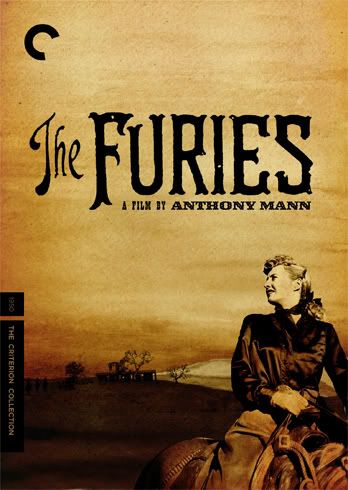
At its core, The Furies is a passionate stand off between a father and a daughter, played by a rip-snorting Walter Huston (in his last role on screen) and a primal Barbara Stanwyck, who dazzlingly alternates between extreme aggression and extreme, childlike vulnerability. As T.C. Jeffords, a wily cattle baron who fancies himself a sort of prairie Napoleon, Huston is in titanic grand old man mold (if you want to see the real genesis of Daniel Day-Lewis’ John Huston-aping Daniel Plainview, look no further). His beady eyes twinkling, T.C. continually asks Vance to scratch his “sixth lumbar vertebrae,” and when you see the outrageously knowing way that Stanwyck scratches her Daddy’s itches, you’ll wonder how Mann snuck this Incest Out West epic past the censors.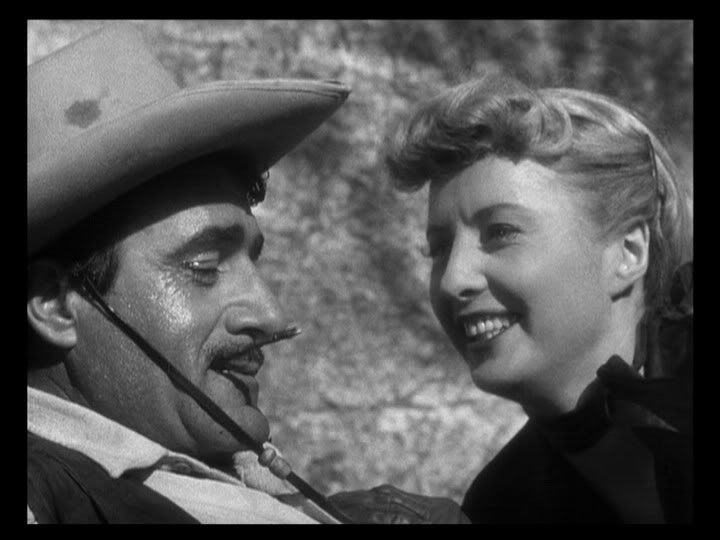
It would take a boatload of Freudian psychoanalysts to unpack all the psychosexual baggage on display in The Furies, all amplified by one of Franz Waxman’s stormiest scores; most of the film is so alarming, and Stanwyck’s Vance is so dedicatedly perverse, that it’s easy to shake off the last twenty minutes or so, which serve as a kind of valedictory for Huston the actor while smoothing out the rough edges of his crude tycoon character. Fascinating as Stanwyck and Huston are, though, in the end it’s Anderson who haunts the film. In her last scene, this former tigress rises to a level of regret that’s practically Shakespearian in its pathos and depth, matching Mann’s obsessive attempts to bring the form of classical tragedy to the western. Her suffering is echoed in the famous scene in Mann’s The Man from Laramie (1955) where James Stewart’s hand gets shot at point blank range, and the sickening scene in Man of the West where Julie London is forced to strip. Mann was always after the root of our worst impulses, and in The Furies, a very messy, provoking film, he came a little closer to those roots than he ever would again, even in the justly lauded movies of his maturity.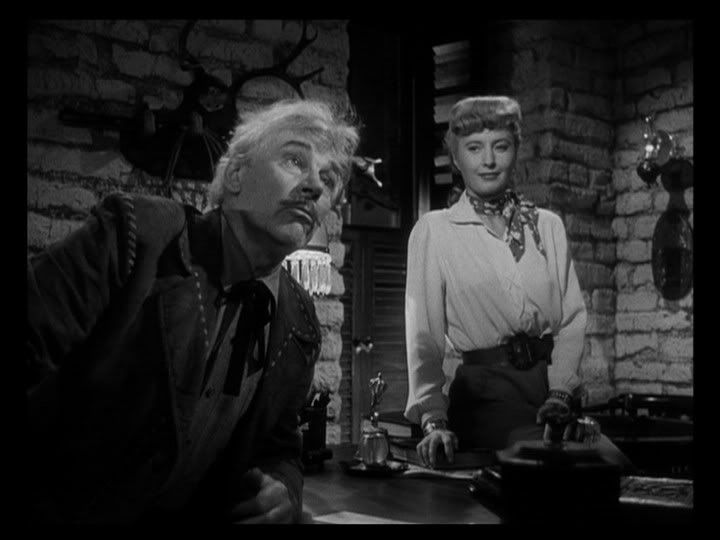
_________________________________________________
House contributor Dan Callahan's writing has appeared in Slant Magazine, Bright Lights Film Journal and Senses of Cinema, among other publications.
Tuesday, May 1, 2007
The Criterion Collection #435 The Furies

The Criterion Collection #434: Classe Touse Risques
By Andrew Chan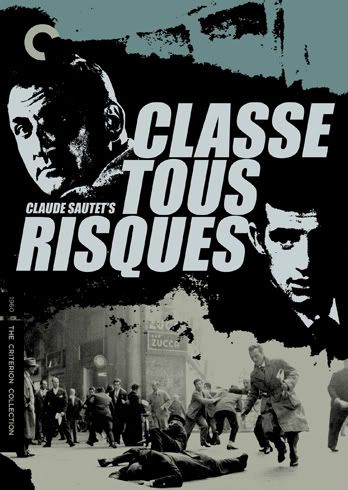
The rediscovery of Classe Tous Risques is, in a way, doubly special, as it leads us to reexamine the work of someone who is not an acknowledged master. Sautet’s career is notable for its lack of ostentation. Having begun as a highly respected assistant director in the ’50s, known for fixing the weak spots in a script and taking the reins from inept filmmakers (Truffaut once called him the “mender of French cinema”), he made a name for himself as a skilled and competent craftsman but not as an auteur. Against the two great superstars of the French New Wave, both of whom made their debuts right around the time Classe Tous Risques was released, he had neither the stylistic flair nor the youthful preoccupations to hold his own. What anchored his films was not the nouvelle vague’s cinephilia or ideology, but rather the ordinary human concerns he found at the center of big genre constructions like the criminal underworld or the comic ménage a trois. For him, even the fantasies of genre were subject to the cruel disappointments of real life.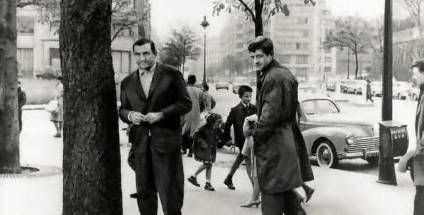
In contrast to the sympathy Sautet extends to the men in César and Nelly, the women (Romy Schneider and Emmanuelle Béart) remain about as enigmatic as the trio of female characters in Classe Tous Risques. Defined by the vagueness of their whims, they are gauzily emotional, steely and unknowable, as if Sautet were paralyzed by the thought of having to enter a woman’s psychology. Accordingly, the representations of and attitudes toward love in these films are uniformly ambivalent, and remarkable for being neither condescending to that emotion nor confined by its intensity. When Ventura—almost at the end of his rope—takes time to fall in love with some random chambermaid, the plot twist serves as nothing more than an evanescent moment of grace, requiring minimal dramatization and no further explanation. Even at the end, love is possible, though it is clear it won’t absolve anyone’s sins or compensate for the greatest human weaknesses.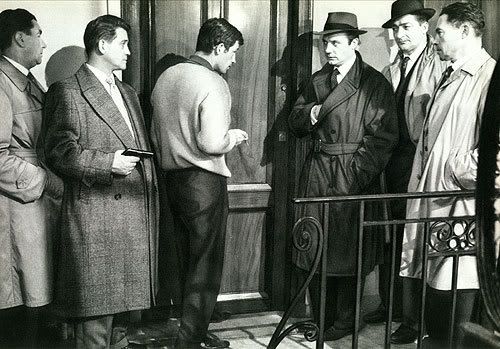
Ventura is great for his role and instantly relatable, his iconic face exuding more life-size decency than movie-size courage or charisma. But here he is largely incapable of communicating the sorrowfulness of a Bogart or the humor of a Gabin—qualities that make a cliché-ridden genre come alive with inner drama. It is Belmondo, with his mixture of toughness, seduction, and angelic innocence, who emerges as the film’s most alluring element, even as Sautet’s elliptical style keeps the character mostly inscrutable. As the hapless hero’s saving grace, Belmondo (fresh off a star-making turn in Breathless) offers the perfect foil to Ventura. More or less at peace with the contradictory extremes of criminal life, he’s as suave as any of the great men of noir, and separate from all the film’s middle-aged hand-wringing.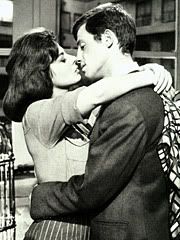
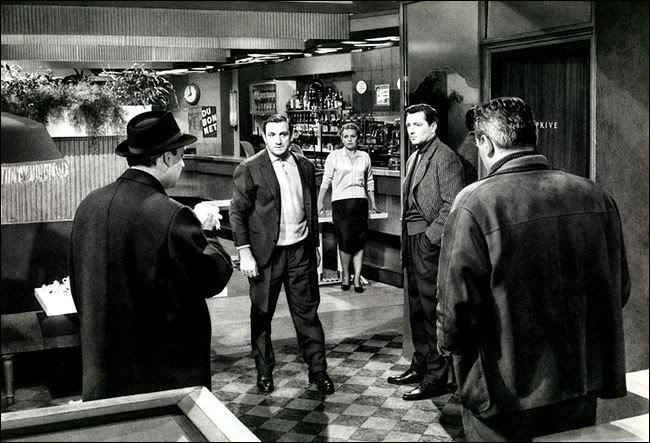
But one trick that Sautet quietly pioneered in both Classe and his later romances is sure to leave a deep impression on anyone interested in taking a closer look at the parallels in his work. His great trademark is a harsh, clipped narrative brevity: deaths and separations and ends of relationships coming so unceremoniously, with so little fanfare, that they show us the swiftness with which life’s changes—and a film’s climax—can occur. In Sautet’s world, as in ours, people depart without warning, without proper goodbyes. And at the end of Classe Tous Risques, Ventura, too, has vanished like an afterthought of the camera, perhaps no luckier or more tragic than the rest of us.
Image/Sound/Extras: The Criterion Collection’s one-disc package boasts a typically beautiful transfer, as well as an impressive collection of excerpts from interviews conducted by French critic N.T. Binh. These include conversations with Sautet, who shares his early experiences in the film industry, and novelist and screenwriter José Giovanni, who relates the true story that inspired him to write Classe Tous Risques. Also included is an old interview of Ventura looking back on his career. Along with the highly informative essays in the set’s booklet—most notable of which is a tribute by Bertrand Tavernier, reminiscing on his double-friendship with mentors Sautet and Giovanni—these supplementary materials emphasize the close bonds forged during the filmmaking process, an insight that complements the film’s focus on the complicated loyalties of male relationships.
Andrew Chan is a poet and film critic currently studying at UNC-Chapel Hill. He is the creator of the blog Movie Love.
Thursday, March 1, 2007
The Criterion Collection #265: Short Cuts
By Jonathan Pacheco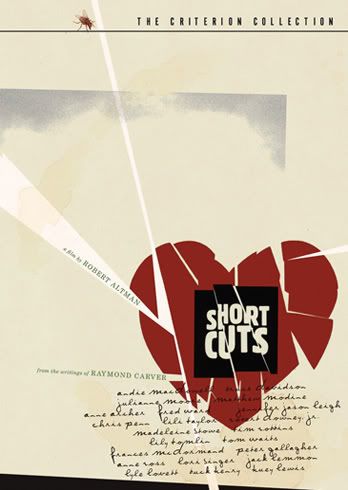
Now, finally, I've met the "big sister."
As Altman has put it, Short Cuts is not necessarily a group of stories, but rather a group of occurrences. It lifts the roofs off houses and peeks in on the conversations. And it's not what the characters are doing that's important, it's the fact that they are doing it (and why and how). The film is not concerned with plot, but with people; the rest will take care of itself. It's a risky approach, and even Altman himself isn't always successful with the method—The Company took a similar tack with a smaller cast and more plot, and it didn't work as well as it should have. But it works in Short Cuts.
One thing that separates Short Cuts from the likes of Magnolia, and which separates most Altman films from the pack, is its unbiased exterior. No melodramatic violin cues are used to manipulate your feelings one way or another. Occurrences and emotions are simply placed in front of you for you to see and experience for yourself. Everything feels very matter-of-fact, and this, coupled with the film's humor, makes Short Cuts seem "light." Yet the objective nature of Altman's directing allows for so many subtleties to brew under the surface, so while the film may play as very funny and relatively happy upon initial viewings, you soon realize that, in a multitude of ways, it's actually a very dark film, laced with tragedy.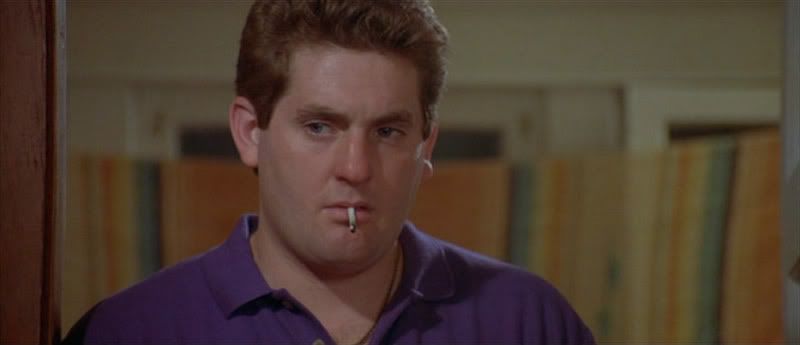
The beauty of Short Cuts is that most of its characters' conflicts aren't said or revealed. The majority of Penn's acting comes through silent expression, and that is one of the goals of Short Cuts: to force the viewer to fill in some of the blanks. As it is with Carver's short stories, it's not what you know, but rather what you remain in the dark about. Possibly more so than in other films, Short Cuts can be understood and interpreted in as many ways as there are people in the world.
I think this is partially why Altman's films tend to look older than they really are. Short Cuts may have been made in the early 90s, but its aesthetic quality and style at times feels straight out of the 70s. In an age with too many steadicam or other fancy shots, zooms seem kind of outdated, but Altman always held on to them, at times putting the slickest dolly shot to shame with his zoom lens. But even his more recent films like Cookie's Fortune have an older feel because of this, and it's really not until the new millennium that Altman's pictures feel more visually "modern." Yet up until and including his final film, the gorgeously photographed A Prairie Home Companion, the zooms remained, and they were just as good as they were in M*A*S*H.
Because of chance, some characters are lucky and some are unlucky. Altman asserts, more or less, that they're the same thing. One person can win the lottery and another person across the globe gets killed at the same time by a falling icicle; good or bad, it's all the same. It's all chance. Looking at the stories of Short Cuts, we see this same randomness, and it's something that the characters must learn to come to grips with. In the story of the Finnigans, we see a family that is very well off. A family that does everything the right way and the safe way, yet it's their child who is struck by the vehicle. It's their child that dies. They think, "Why? Why us?" But why not? What they have to come to realize is that there is no "why." There is no reason why their son died, just as there is no real reason why the two-timing cop (Tim Robbins) ends the film with a happy family. Their lives, according to Altman, and Carver (in a way), are just random.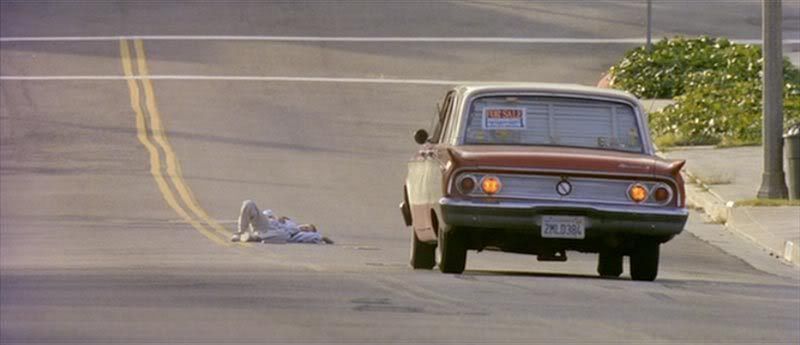
It's difficult to do justice to the film's various threads because there are so many facets to each of them. But reflecting on Short Cuts, I dwell more on certain moments and fragments: Earl (Tom Waits) and Doreen (Lily Tomlin), happy once again in their trailer, but for how long? Gene, the cop and sleazeball, standing as a hero to his family, his wife in his arms. The baker (Lyle Lovett) offering muffins to the Finnigans. The reveal of the dead body during the fishing trip. Jack Lemmon, as Howard Finnigan's estranged father, delivering a beautiful confessional monologue. Jerry's face as he listens to his wife perform her job. These moments and so many more serve as fragments and pieces of a brilliant whole. It's fitting that the Criterion Collection DVD of Short Cuts features a shared motif on its cover and its menus of a heart shattered into fragments. They're broken pieces, yes, but they still form a heart.
As is to be expected, Altman's movie has its share of grain and the occasional film jitter, but a good job is done eliminating every other visual nuisance. The DVD also features a couple of disappointing deleted scenes (too short) and the usual trailers and TV spots, along with a nice archive of poster mock-ups that were part of a preliminary marketing campaign. There's also a lengthy look at Carver's life via a PBS documentary, as well as an audio interview with the late writer. He's more down-to-earth than I would have expected, but he never short-changes himself either; he knew when he did good work, and he is happy to discuss it. The one piece that's made specifically for the Criterion disc is a reflective half-hour conversation between Tim Robbins and Robert Altman. It features several good insights from both the actor and director, not only on making Short Cuts, but how they interpret the film when they watch it now.
Luck, Trust and Ketchup is a feature-length documentary on the making of the film (some video glitches at the bottom of the picture lead me to believe that the source material was transferred from tape). It's decent enough as a documentary, with some informative interviews from Carver's widow, some of the film's actors, and Altman himself, though most of the filmmaker's insights are found almost verbatim in the short stories' foreword. The real reason to see the feature is for the clips of Altman as he directs. It's one thing to read about the director's process or to hear him speak on it, but it's totally another thing to see the man in action. There are times when he's very specific about what he wants and there are times where he merely sits back, chuckling his head off at a scene, and turning to the documentarian's camera as if to say, "You getting this?"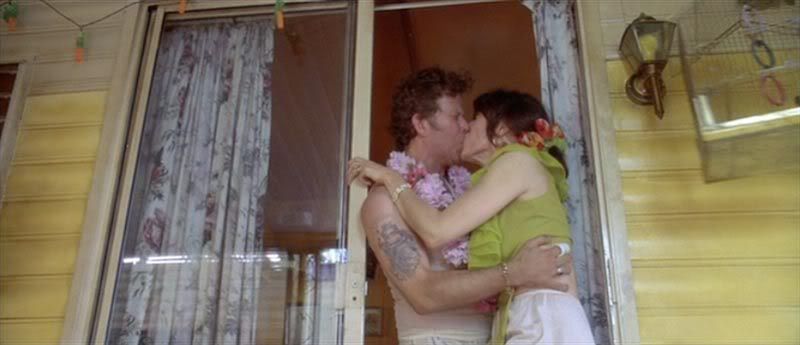
Jonathan Pacheco is a current web developer and future freelance writer. He blogs and reviews films at Bohemian Cinema.